


 Advanced Search
 First To Fight Kits FTF029


- Description:
- Vickers E with the single turret
- Manufacturer:
- First To Fight Kits
- Code Number:
- FTF029
- Scale:
- 1:72
- Item type:
- Military vehicle kits (injection)
- Price:
- £9.99
- Order Quantity:
- Quantity In Stock:
 10+
10+
- Availability:
- This will usually be dispatched within 24/48 hours of receiving your order
- Wish List:
- Department:
- Catalogue
GPSR information:- Manufacturer Email:
- firsttofight@wrzesien1939.pl
- Manufacturer Address:
- First to Fight Sp. z o.o. , , ul. Jana Bu?haka 11 , , 01-472 Warszawa
Here are some books and decals you might find useful for this kit
Found 12 related products
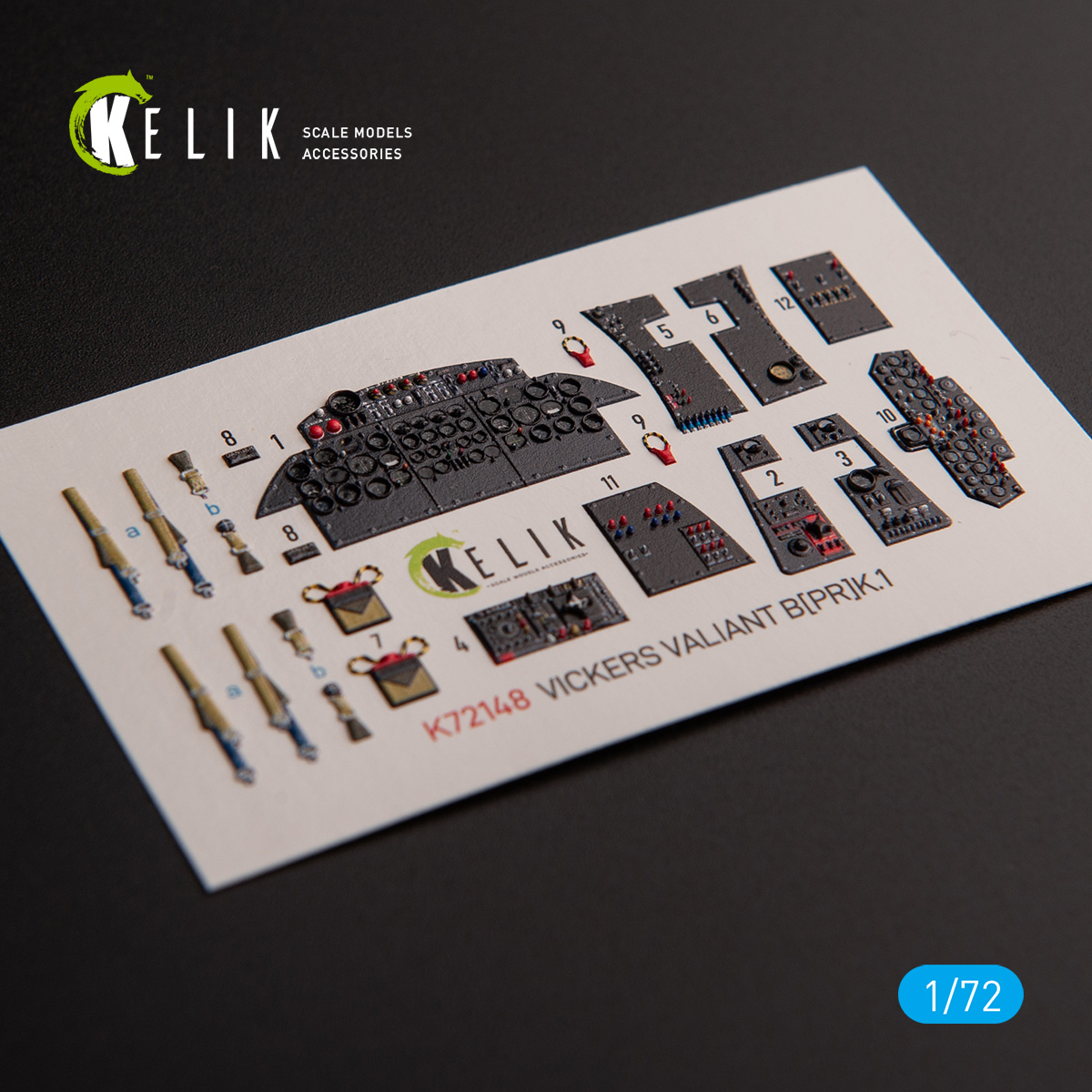 | Kelik - K3D72148 - 1:72 | Vickers Valiant B(PR)K.1 front cockpit - cockpit interior/instruments 3D-decals (designed to be used with Airfix kits) More | Aircraft decals (military) | Catalogue | £12.80 | |
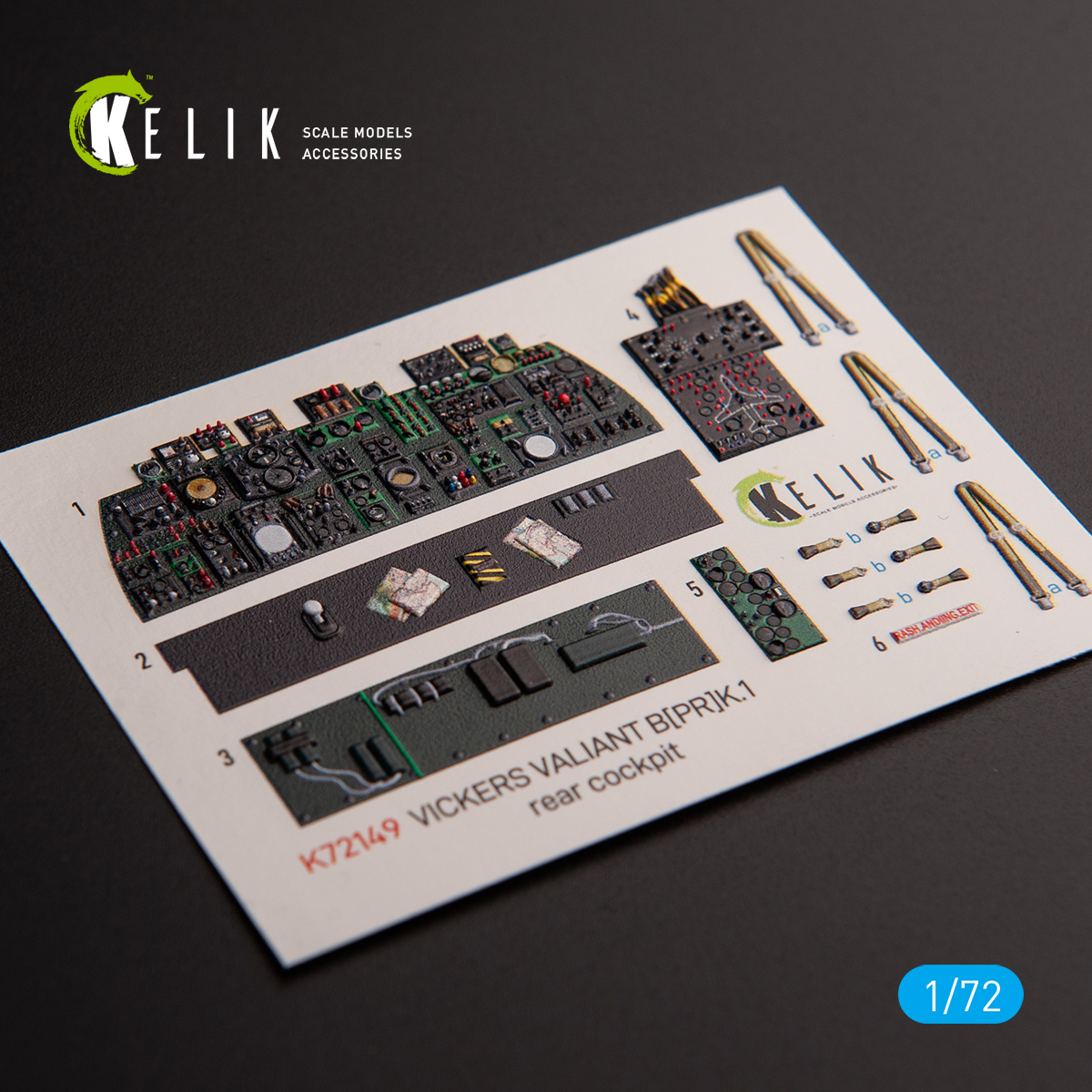 | Kelik - K3D72149 - 1:72 | Vickers Valiant B(PR)K.1 rear cockpit - cockpit interior/instruments 3D-decals (designed to be used with Airfix kits) More | Aircraft decals (military) | Catalogue | £14.50 | |
 | Kora - KORD72343 - 1:72 | Vickers Wellington Mk.IC Luftwaffe Part II (designed to be used with Airfix, Eastern Express, FROG, NOVO, MPM and Trumpeter kits) More | Aircraft decals (military) | Limited Availability | £8.50 | |
 | Kits-World - KW3D1721025 - 1:72 | Vickers Wellington B Mk.I - 1/72 scale 3D Full colour Instrument Panels - (designed be used with Airfix kits) More | Aircraft decals (military) | Catalogue | £9.99 | |
 | Tigerhead Models - THD72007 - 1:72 | Turkish Spitfires. The Spitfires designed and produced by the British firm Vickers Supermarine participated the Battle of Britain and most probably they are the most popular fighters of WWII. Different models arrived Turkey at different times. A batch of 15 Supermarine Spitfire Mk.Is were ordered together with the Hawker 'Hurricanes' but only 3 of them were delivered. One of them which was an ex-Polish order arrived in Sept.1938. The other two arrived in 1940. Eventhough serials 4501 to 4515 were allocated by the TuAF they were never used. The planes were deployed at the 42nd Hunter Company. Two of them were returned to RAFME in 1942. The Mk.Is were equipped with a Rolls Royce Merlin-2 engine with an output of 1030HP. Their armament consisted of 8 pieces 0.303 caliper MGs. They were distinctive with their 3-blade propeller. No other Supermarine Spitfire was supplied until mid-1944. In July 1944 39 pcs Mk.Vb was sent from RAF stocks. This was followed by 71 pcs Mk.Vc's and 3 recce version Mk.V/R came in February 1945. Mk.Vb's were deployed at the 1st and 2nd Co.s of the 5th Regiment, 1st, 2nd and 3rd Co.s of the 6th Regiment. The Mk.V/Rs were used with the 'High Altitude Photo-Recce Unit'. These models were distinguished with their four-blade propellers. According to the TuAF sources they were equipped with Rolls Royce Merlin-20 engines with an output of 1500 HP. But the British sources state that the Mk.Vb's were equipped with a 1585HP Rolls Royce Merlin 45M engine and the Mk.Vc's with a 1470HP Rolls Royce Merlin 45 engine. The standart armament of the Mk.Vb's were 4 pcs 0.303 caliper MG and 2 pcs 20mm cannon whereas the Mk.Vc's had 4 pcs 20mm cannons and they were capable of carrying a bombload of 500lbs. They were replaced by the P-47 'Thunderbolts' in 1948. After the WWII, the TuAF was inclined to make the 'Spitfire's her standart interceptor-fighter. An aggreement was signed with the Britsih firm Vickers for the overhaul and maintenance of the 'Spitfire's. In between Jan.1947 and Feb.1948 170 pcs Mk.IX were received. These planes were deployed at the 1st, 2nd, 3rd Co.s of the 4th Regiment, 3rd & 4th Co.s of the 5th Regiment 1st, 2nd, 3rd & 4th Co.s of the 7th Regiment and 1st, 2nd, 3rd & 4th Co.s of the 8th Regiment. Some of the planes were then transferred to the 1st, 2nd, 3rd & 4th Co.s of the 6th Regiment in 1949. After the reorganization of the TuAF they were deployed at the 4th & 6th Air Bases in 1951. They were written off in 1954. The Mk.IXs were equipped with a Rolls Royce Merlin 61 with an output of 1475HP. Their armament varied (some were equipped with 8 pcs 0.303 Caliper MGs whereas some were equipped with 4 pcs 0.303 caliper MG plus 2 pcs 20mm cannons. Some even had 4 pcs 20mm cannons and they were capable of carrying a bombload of 500lbs. Only one Supermarine Spitfire M.XI arrived. The exact date of arrival and deployment is not known. It was assigned to 'High Altitude Photo-Recce Unit'. 4 pcs Mk.XIX were sold to Vickers by the RAF to make the overhaul. These planes were brought to Turkey in March 1947 and they were also deployed at the 'High Altitude Photo-Recce Unit'. These planes were equipped 2 cameras underneath the fuselage an done each on the port and starboard sides of the fuselage. They were the most powerful Spitfires equipped with a 2035HP Rolls Royce Griffon engine. They are distinctive with their five-blade propeller. More | Aircraft decals (military) | Catalogue | £9.99 | |
 | AIM - Transport Wings - TWL72075 - 1:72 | Northeast Airlines (UK) Vickers Viscount 806 - Circa 1972 (designed to be used with the Mach 2 Viscount 700 kit and Transport Wings Viscount 800 conversion set) More | Aircraft decals (civil) | Limited Availability | £15.12 | |
 | Warpaint Series - WPS10 - No Scale | Vickers Wellington AUTHOR: Hall, A FORMAT: 30pp col/Bw/dwgs 297x210 Pb Designed with both the aircraft enthusiast and the modeller in mind, this series offers a comprehensive and accurate account of a single aircraft type within each issue. Drawings provided in both colour side and plan view with 1:72 scale plans, kit decal and accessory lists, squadrons, units and individual aircraft serials in codes, etc. The Vickers Wellington was one of those aircraft that seemed to go on for ever. In spite of the glamour and publicity gained by the Lancaster & Halifax, Wellingtons flew operationally for much longer during World War 2 and were still in side spread use for some considerable time afterwards as a trainer aircraft both for pilots and multi-engine aircraft and as crew trainers. (Mk.IC Mk.II Mk.III Mk.IV Mk.VIII Mk.X Mk.XIV] More | Aircraft books | Catalogue | £13.00 | |
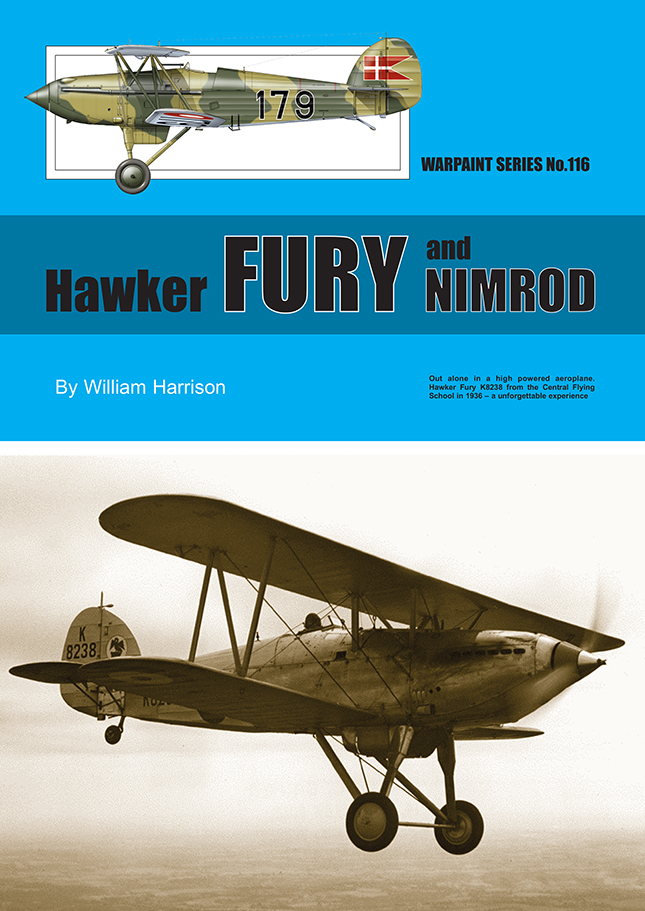 | Warpaint Series - WPS116 - No Scale | Hawker Fury and Nimrod Author: William Harrison The first RAF front line fighter to achieve more than 200 mph was the Hawker Fury, and its naval counterpart the Hawker Nimrod. These two attractive fighters came from the design office of the late Sydney Camm, Hawker's chief designer. The Fury started life as a private venture known as the Hornet but when this machine exceeded expectations the name was changed to Fury. Although only ordered in small numbers owing to financial constraints during the Great Depression production eventually exceeded 260 machines with orders from the RAF, Royal Navy, Persia (now Iran), Portugal, Spain, Yugoslavia and more than 30 supplied (ex-RAF) to the South African Air Force. The Fury entered service with No.43 Squadron who accepted 16 during May 1930 and stayed in front line service until January 1939 when it was replaced by the Gloster Gladiator, although quite a few remained in the training role until mid-1941. The Furies were used in combat during WWII by Yugoslavia where they were quickly despatched by the more modern fighters of the Luftwaffe. South Africa used Furies in the East African war until 1941 and the three supplied to Spain were in action, one of them serving on both sides! The Nimrod, while bearing a distinct resemblance to the Fury, flew early in 1930. Changes for the RN included longer exhaust pipes extending down both sides of the fuselage as far as the pilot's cockpit; an oil cooler fitted beneath the engine bay and at a later date arrester gear was fitted for carrier use. Later series Nimrods featured a larger tail surface to improve inverted spinning characteristics when fitted with floats. Deliveries of Nimrods started in September 1933 and they remained in use until May 1939. Only a small number of Nimrods found their way abroad, two went to Denmark to act as pattern aircraft for licensed production, one was shipped to Japan and one to Portugal. Although one Fury managed to survive in the scrapyard of a London dealer it fell to John Isaacs, a draughtsman from Vickers Armstrong, to design and build both a 1/7th scale Fury and Spitfire, both of which continue to be built by members of the Light Aircraft Association, nee the Popular Flying Association. This book is written by William Harrison and is superbly illustrated by Richard J.Caruana. More | Aircraft books | Catalogue | £16.00 | |
 | Warpaint Series - WPS141 - No Scale | Vickers Viking, Valetta & Varsity In Military Service. By Adrian M. Balch £19.00 56 pages The Vickers VC.1 Viking was a British twin-engine short-range airliner derived from the Vickers Wellington bomber and built by Vickers-Armstrongs Limited at Brooklands near Weybridge in Surrey. After the Second World War, the Viking was an important airliner with British airlines, pending the development of turboprop aircraft like the Viscount. The Valetta was a military derivative of the Viking developed in transport and training variants for the Royal Air Force, while the Varsity was a versatile twin piston-engined aircraft developed from the Viking and Valetta but with a tricycle undercarriage and ventral pannier for bomb-aimer training, among other changes. It was brought into RAF service in 1951 for crew training as a replacement for the Wellington T.10. This Warpaint relates the history of all three types, focussing on the military operators, as per the series title. It is profusely illustrated by 125 top quality photographs, nearly all in colour, from the author's extensive photograph archive and supported by excellent colour profiles and plans by Sam Pearson. More | Aircraft books | Catalogue | £19.00 | |
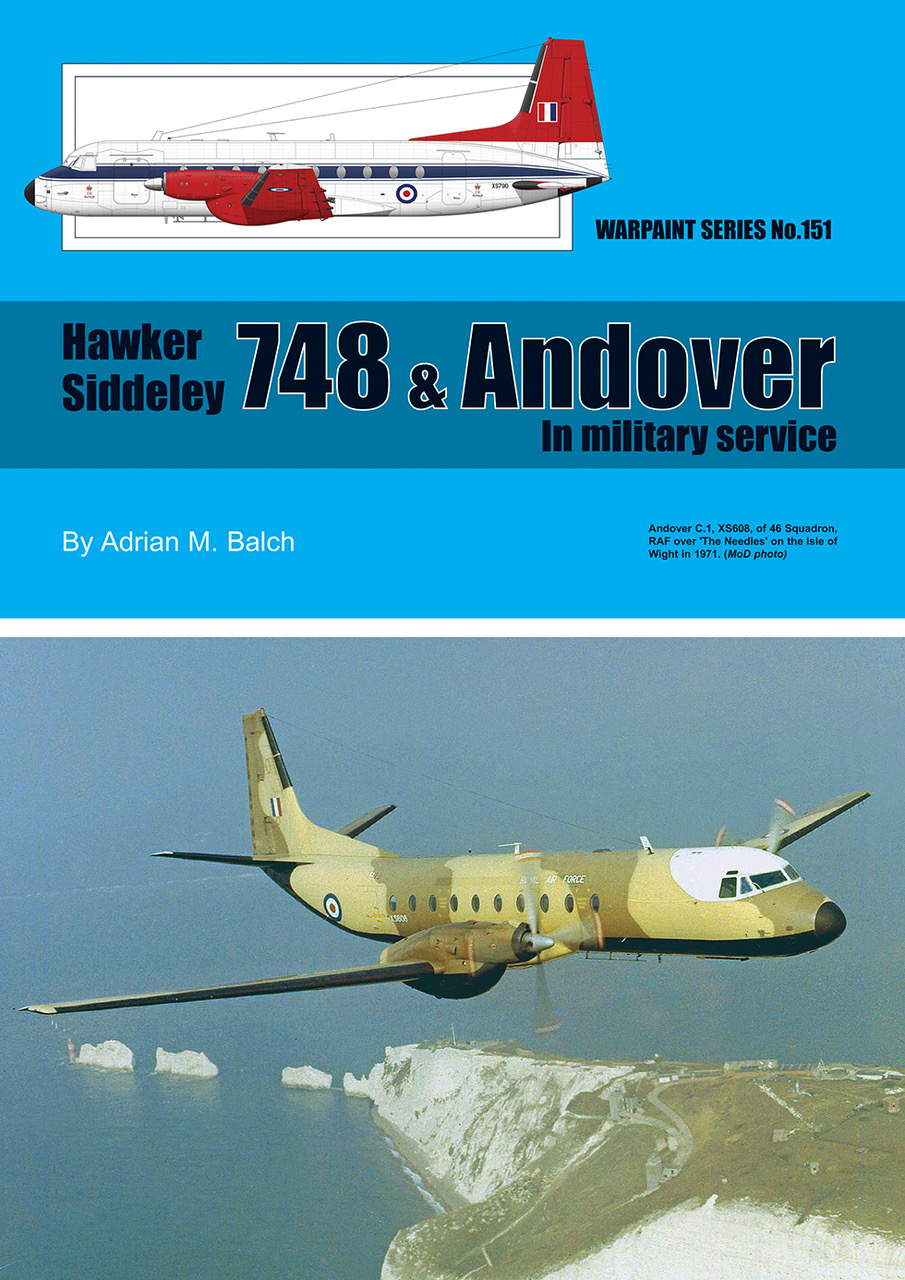 | Warpaint Series - WPS151 - No Scale | Hawker-Siddeley 748 & Andover in Military Service. Author Adrian Balch 56 pages Making its first flight on 24 June 1960 the prototype AVRO 748, G-APZV, became a very successful rugged replacement for the many DC-3 Dakotas flying around the world. In production, it became the second most successful British turboprop transport aircraft and was only superseded in numbers produced by those of the Vickers Viscount. A total of 381 Hawker Siddeley HS 748 aircraft were built, including eighty-nine manufactured under license by Hindustan Aeronautics Limited (HAL) in India, with production running from 1960 to 1988 for this successful turboprop airliner and its military variant, the Andover. The total included, thirty-seven Andovers for the RAF and RNZAF. Over fifty military HS 748s were sold, seventy-two for the Indian Air Force, plus others for RAAF, Brazilian Air Force and others, making a substantial portion of the 381 total built, with many going to various air forces worldwide for roles like transport, navigation training and VIP transports. The HS748 was selected for the Royal Family as the Andover CC.2 and three of them served The Queen's Flight faithfully and reliably for over twenty years from 1964 There are other publications that focus on all the civil airlines that have operated the HS748, but as a Warpaint publication, this is the first time all those that saw military service with air forces around the world have been featured-and nearly all in over 160 top quality colour photographs with notes on colour schemes and markings. This is another quality Warpaint by author Adrian Balch, supported by accurate profile drawings by artist Sam Pearson and a must-have addition for aviation historians and modellers alike. More | Aircraft books | New Arrivals | £18.00 | |
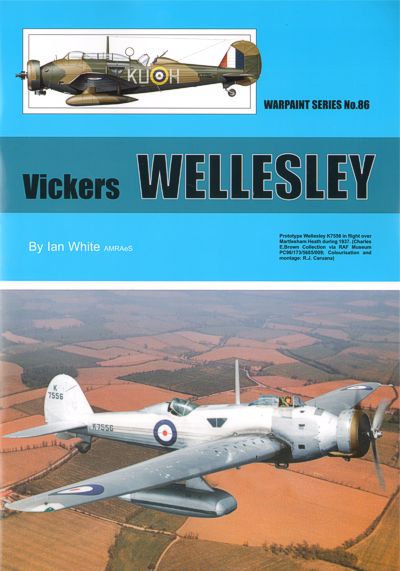 | Warpaint Series - WPS86 - No Scale | Vickers Wellesley by Ian White. Created on the drawing boards of the Vickers (Aviation) Company by Barnes Wallis using the geodetic form of construction he devised for Britain's R.100 airship, the Wellesley was designed to fulfil an Air Ministry specification for a reliable, general purpose bomber and torpedo-bomber, that was required to carry a heavy load over long distances. Originally conceived as a biplane, but converted to an all-metal geodetic monoplane by Barnes Wallis, and powered by the highly reliable Pegasus radial engine, the Wellesley was built in reasonable quantities to begin the re-equipment the embryo Bomber Command in 1937. Following testing at Martlesham Heath, the first production Wellesleys were delivered to the RAF early in 1937 and within one year formed the equipment of six UK squadrons. The Wellesley's flying qualities were such that it was chosen to equip the RAF's Long Range Development Unit, under whose guise it undertook a record breaking flight from Cranwell to the Persian Gulf and back to Ismailia in July 1938 and a second from Ismailia to Darwin, Australia, the following November, when the aircraft covered a distance of 7,157 miles without refuelling. By the outbreak of war the Wellesley was rendered obsolete in the European theatre, but was supplied in large numbers to re-equip the RAF's squadrons in the Middle East and East Africa. It was in the latter theatre that the aircraft showed its true metal. Supported by dedicated ground crews and the ever reliable Pegasus engine, the Wellesleys of Nos.14, 47 and 223 Squadrons battled the Italian Regia Aeronautica and the Italian Army in the Sudan, Abyssinia, Eritrea, Somaliland the Red Sea from June 1940 to November 1942. Despite being decidedly obsolete by the early months of 1943, the Wellesley was employed on transport, anti-submarine and convoy protection duties in the Eastern Mediterranean until March of that year, when the small number that remained were finally retired. More | Aircraft books | Catalogue | £14.00 | |
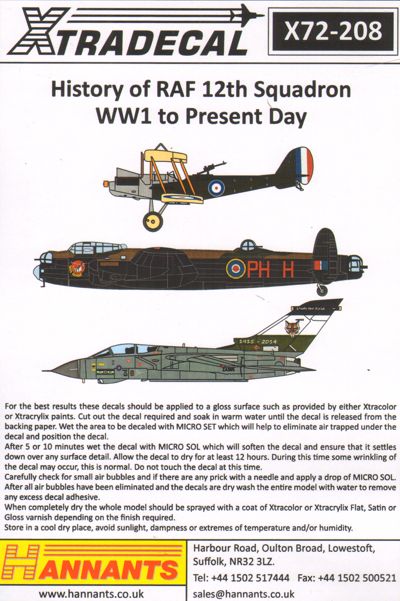 | Xtradecal - X72208 - 1:72 | The History of 12 Squadron 1915-2014(9) Royal Aircraft Factory RE.8 F6097 Lt Croye Rothes/2nd Lt Hervey Rhodes; Fairey Battle P2332 PH-F and G, J, K and N Maastrict Bridge raid 1940; Vickers Wellington Mk.II W5421 PH-G Merlin engines lost 5/8/41; Vickers Wellington Mk.III B1780 PH-W Hercules engines; Avro Lancaster B.I/III LM321 PH-H with nose art; Avro Vulcan B.2 XM602 Coningsby anti-flash white; Blackburn/Hawker-Siddeley Buccaneer S.2B XX895 1970s; XX885 ex Gulf War overall Med Sea Grey Lossiemouth; Panavia Tornado GR.4A ZA395 in Squadron disbandment scheme 2014 [Blackburn/Hawker-Siddeley Buccaneer S.2B] More | Aircraft decals (military) | Catalogue | £7.99 |
Hannants Search Engine
Convert Currency
Copyright © 2001-2026 H. G. Hannant Limited. All rights reserved. | Website by Dessol
Privacy Policy | Cookie Information | Switch to Mobile Version
